by Gabriele Brandstetter
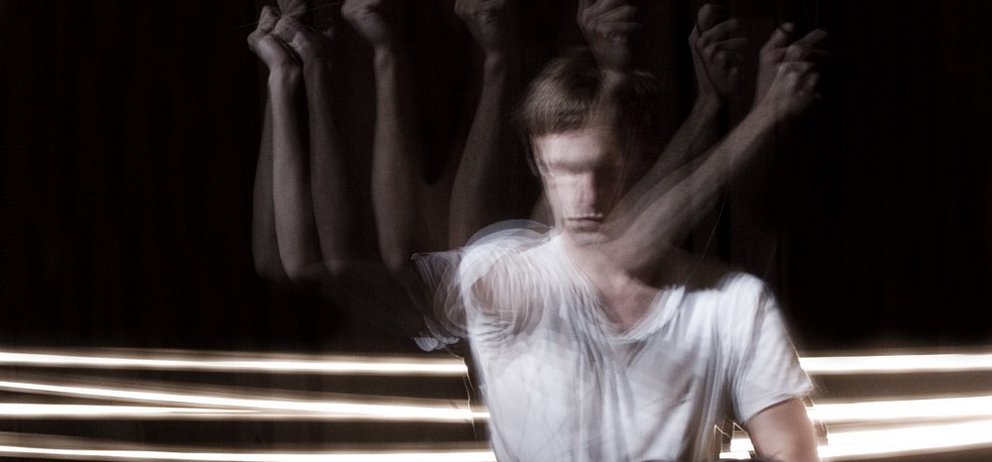
Echorooms – Jefta van Dinther’s Choreography into the Open
“In turbulent times, the only reliable thing
is the observation that even military power can falter ...”
Alexander Kluge in “Sand and Time”, 2025
Through his choreographic work, Jefta van Dinther has generated experimental arrangements that conceive of bodies and their environments as echo chambers. ‘Echo’ here is not only intended in an acoustic sense, but also, more generally, as a type of resonance. How can the body’s inner and outer fields be explored through dance? How can the material and immaterial traces that are inscribed in the body be identified?
A basic assumption in Van Dinther’s work seems to be that a body is not a fixed entity; rather it is in a constant state of flux. A body contains traces of individual and collective stories that continuously accrue in overlapping ‘layers’ – inscriptions of physical and psychological experiences stemming from both giving into and resisting social norms. These layers both conceal inner battlefields and past traumas, and keep the memory of the most intense moments of intimacy and ecstasy. A body is always becoming more deeply marked by learned conventions, ‘doing gender’, experiences of transformation, embodied behaviour patterns, repeatedly practised (dance) trainings, desire, and scars of grief and pain. This process renders every body a kind of palimpsest that contains traces of emotional experiences, both positive and negative.
A basic assumption in Van Dinther’s work seems to be that a body is not a fixed entity.
Van Dinther explores these body-palimpsests. Through the most delicate micro-invasive investigations, he creates choreographic arrangements that carefully pull back the surface to reveal the hidden layers underneath. This work is methodologically rooted in somatic practices. Van Dinther explores with his dancers the ways that movements that normally unconsciously occur in the body’s cavities can be sensorially mobilised to express the inner physical and psychological self. This exploration is undertaken through the embodiment of both real and fictional ideas of anatomy, especially focussing on the inner organs of the body. The mobilizations that this achieves, in turn, enables this self to reach out and make contact with the audience.
How do these subcutaneous somatic dynamics affect the perception of others and of the environment? How is the impulse transmitted both in proximity and across distances? And how do the close examination of physical and interpersonal cavities impact the intensity and intimacy of relationships?
The titles almost always open up a second level or kaleidoscopic spectrum of interpretations.
Despite the intimacy and passionate patience displayed while exploring the innermost physicality, Van Dinther’s choreographic anatomy is by no means hermetic. On the contrary, his constant emphasis on the need for kinaesthetic empathy – for tuning in to feelings and interpersonal care – has an appeal that is gaining political significance in times of crisis such as those we are currently living through. By recognizing bodies as palimpsests, Van Dinther reveals the human ‘building material’ that incites protest and resists violence. These echo chambers foreshadow and premonish an alternative humane future.
Politics of titles and headings
Titles of artworks present challenges for both their producers and their readers. They require decisions about the possible effects of headings. Titles that specify, define, or describe the content can limit the imagination or stimulate it, thus narrowing the range of possibilities. In contemporary art and photography, many artists therefore choose not to give their work titles: Untitled / Ohne Titel / Sans titre. It is interesting that this rarely occurs in the performing arts. ‘Untitled’, which is itself a form of heading, is virtually non-existent in theatre and dance. Titles are transmitters. They serve as bridges. Van Dinther is well aware of this. In titling his pieces, he plays with the subtle opportunities offered by the ambiguities of language. The titles almost always open up a second level or kaleidoscopic spectrum of interpretations. For example, the title “Kneeding” (2010) melds the words ‘kneading’ and ‘needing’, vividly capturing the links between the emotional and physical needs of the three dancers on stage and their kneading movements. The title also suggests that the body can be worked like dough and can be kneaded.
After all, our body is dark to us; the relationships between its internal and external aspects are hidden.
The title of the duo “THIS IS CONCRETE” (2012) is similarly ambiguous. It refers to the physical reality of the body in relation to itself, others, and the environment. At the same time, ‘concrete’ also alludes to hardness and solidity of the materials used to build stages, theatres, buildings, cities, etc. The word ‘concrete’ also indirectly evokes its antonyms– not-concrete, immaterial, abstract, imaginary. The title suggests that the intimacy between the two male performers is concrete, but in what ways is this concrete? During the piece, the men lie entwined on the floor for a long time, moving slowly and merging into one another. The atmosphere of desire and sensuality that emerges between them is supported by the lighting and soundscape. The seemingly concrete physical materiality of the bodies of the two men reveals itself to be ephemeral, transcendent and transient.
The title of Van Dinther’s 2017 duet – “Dark Field Analysis” – is drawn from alternative medicine. In that field, it refers to a way of analysing blood with a specific type of microscope that contrasts the blood against an unilluminated background. By using it to title his piece, Van Dinther has given this term a multiplicity of meanings. The symbolic dimension of the phrase ‘dark field’ connects with the microsomatic aspect of Van Dinther’s work on anatomy, movement, and the body’s fluids and organs. After all, our body is dark to us; the relationships between its internal and external aspects are hidden. The result, as suggested by the title, is a choreography that explores ‘dark fields’ and searches for their complex physical and social patterns of exchange.
“AUSLAND” proves to be a kind of spatial labyrinth, a playground without a clear path.
“AUSLAND” (2024) seems, at first reading, to be a clear, straightforward title. This is the German word for ‘foreign land’ or ‘abroad’. However, upon closer examination, the term does not indicate where abroad begins. During the piece, the audience becomes aware that there is a blurry boundary between home and abroad. These two categories shift again and again. Are we in or out? Above or below? Is this space inside and that outside? Is abroad to be found in the knot of foreign, unattainable human bodies? Can it be located in the movements of dissolution? What about in the shifts and changes to the spaces occupied by everyone, including the audience? The piece suggests a critique of our current politics. The critical-political thrust of this title suddenly becomes clear: ‘Ausland’ is not ‘where I am not;’ rather, ‘Ausland’ is everywhere! It runs right through the middle of bodies and societies.
This reading of the term ‘Ausland’ structures this piece. It shows that this is an exploration of risky zones. This is the space of a strangeness that simultaneously touches on existential tensions and opens up the pathways towards change, transformation, and, ultimately, utopia. The polyvalence of this title challenges the audience to leave the familiar behind and to pursue alternative realities through play and contact with others. “AUSLAND” proves to be a kind of spatial labyrinth, a playground without a clear path. During the first staging at Kraftwerk in Berlin in 2024, audience members were invited to explore the cavernous space as they pleased. They were free to go up and down stairs, walk further in or come back to spaces they had already visited. They were allowed to follow their own desires, curiosities, and lusts, as if they were newly stranded on an island in an ‘outland’ archipelago.
These migratory movements create an immersive pull. Human and non-human actors encounter each other in constantly changing scenes—wandering spectators move alongside the dancers, like a sluggish crowd, on a journey where the familiar and the unfamiliar collide. Clothed and naked bodies. Machines. Devices. Piles of mattresses. Robot vacuum cleaners. Monowheels. Giant loudspeakers. “AUSLAND” is a durational performance lasting approximately three hours. During this period, the audience is taken on a ‘time-out’ into a strange, temporary state where boundary crossings are possible. Shifting the borderlines to ‘foreign lands’ displaces fixed attitudes and subversively marks the boundaries between freedom and violence. “AUSLAND” leaves its visitors free to explore their own foreign territories: desire and resistance in a web of seriousness and play. A video-animation reflects the Sisyphean task of fixation on certain processes, especially mechanical ones, and contrasts with the lostness of the individual, as demonstrated in Van Dinther’s solo performance in front of the video. The scenes, spaces and encounters evoke unfamiliar and strange experiences, leaving visitors free to explore their own foreign territories: desire and resistance in a web of seriousness and play; attachment to old patterns and departure into other realms of experience.
In “Grind”, the body becomes a strange somatic landscape, confusing the viewer’s mental anatomical atlas.
Anatomies: Body Cavities and Machines
Many of Van Dinther’s works are guided by anatomical experimentation in the original Greek sense of the term—the dissection of bodies into parts, the penetration beneath the skin, and the inspection of cavities that are not visible to the naked eye.
“GRIND” (2011) explores the effects of a specific kind of dual anatomy structured by the dissection of bodies and body cavities by way of, mechanical processes. The term ‘grind’ refers to mechanical actions often used in industrial manufacturing that abrade objects through milling. In the performance, moments of grinding are created through colliding with the steel-like back wall, working with cables, and interacting with explosive lighting effects. Van Dinther also explores the anatomy of dance forms associated with the term ‘grinding’, such as Perreo, Lambada, and Hip-Hop. These movements result from somatic activation of the resonances in and between bodily cavities, as well as from touch and rhythmic vibrations. Sound, light and ecstatic physical movement combine to create a synesthetic assemblage of body and machine.
During the piece, the body is broken down into individual parts by strobe lights and shadows. These parts appear like sculptures in torchlight, divided into limbs, cavities, and contortions. Contours change elastically, oscillating between their ‘morphe’ and amorphous forms. ‘Morphe’ is the Greek meaning of form – ‘Gestalt’ – and here it is used as the counterpart of the amorph, in reference to the constant metamorphoses and transformations that are part of the body concept of Van Dinther. The body becomes a strange somatic landscape, confusing the viewer’s mental anatomical atlas. An armpit, the back of a knee, a bent hip, and a mouth each seem to be a hole in the flesh. Cavities turn inside out and outside in, generating a constant transgression of both types of space. The choreographic interplay between what is visible and what eludes the gaze shifts perception between illusion and reality, between the imaginary and the concrete sensual presence.
In this piece, Van Dinther uses somatic training methods as artistic tools for evoking certain physical state and perceptions, rather than as just ends. Feeling the movements that take place inside the body – breathing, the movement of the diaphragm, the movement of the organs and bodily fluids – enables the mobilisation of external movements with a different somatic quality. This emphasis on the impulses of internal micro-movements is not directed towards conventional ‘dance’ forms nor towards predetermined movements. Instead, somatic practice is used as a choreographic resource to activate gravity and balance, rendering states of intensity and instability synaesthetically accessible. Van Dinther’s approach, which transcends conventional dance techniques, transforms the body into a medium for sensory resonances. The audience is drawn in by the permeability of bodies, their porosity, and the transfusion of perceptions of seemingly inaccessible inner processes. This is a journey into the unknown river landscapes of somatic zones.
In “Plateau Effect”, body cavities interact with and contrast against technical devices and work instruments.
“Kneeding” (2010) uses somatic methods to explore resonance phenomena in the flow between the inside and outside of individual bodies, as well as in between the bodies of three dancers on stage. Whether standing or sitting, the dancers generate their movements from the inner spaces of their bodies – pumping, vibrating, rhythmically undulating, stretching and contracting motions of the torso. These movements are mobilised and synchronised from the centre of the body, specifically the chest, diaphragm and abdominal cavity. The body thus appears as a malleable substance that is moulded into different shapes. In this way, the performers connect from within to the environment, the other dancers, the space, the sound, and the audience. Proximity and distance are experienced indirectly, through the resonance in space that transmits flowing positive and negative energetic charges. The innermost processes, such as the micro-somatic movement of cells, enter into a relationship with the outside—with both other bodies and external technical devices. The work choreographically explores the relationship, as well as the gaps, between physical and psychological forces—between ‘kneading’ as a sensual-physical gesture, and ‘needing’ as a state of desire.
In “Plateau Effect” (Cullberg Ballet, 2013), the dancers work in a completely different way, using body techniques based on somatic practices. Body cavities interact with and contrast against technical devices and work instruments. Through a process of group cooperation, an open scene gradually unfolds that has the structure of a ‘somatic choreography’. On stage, the dancers’ movements do not appear to be choreographed in the traditional sense. They are not repeating rehearsed steps or gestures. Rather, they are responding in the moment to micro-movements that transmit impulses from within the body. At the same time, they are also working from movements arising from the need to muster the strength, the tension, and the counter-tension necessary to repeatedly stretch and fold a huge fabric sail in different ways. In this dramaturgy of tension, the somatic principles of breath, inner impulses, and weight transfer take on a collective dimension. Tensions build until a plateau – a temporary state of equilibrium and stagnation – is reached. The density of the synergetic forces on stage unconsciously affects viewers through kinaesthetic empathy. They become aware of the social relevance of the labour – of moving together in a process of negotiating resistance, adjustment, and, also, disturbance, which, in turn, demands attention and reactions to unforeseen situations on stage.
Soundscapes: choir cascades and voice cathedrals
As seen in “Unearth” (2022) and “REMACHINE” (2024), the cavities of the body form not only the physical basis for movement but also the spaces of sound and voice resonance in Van Dinther’s works. The sound generated by the performers’ voices is not an externally applied, technically produced soundtrack. It is not ‘music’ to which people dance. Rather, Van Dinther experiments with the possibilities of an embodied voice in a way that makes the voice within the body central to the choreography. How can the sound of the voice be modulated by mobilising the body’s resonance spaces (organs, fluids) and its spaces of resistance (skeleton, joints)? How do voices connect, synchronise and overlap through different bodily rhythms of breathing, heartbeat and movement?
It is not ‘music’ to which people dance. Rather, Van Dinther experiments with the possibilities of an embodied voice in a way that makes the voice within the body central to the choreography.
In “Unearth”, ten dancers move through the space in a durational performance while visitors stand, sit and linger amongst them. Through slow, repetitive movements such as sitting or crawling on the floor for extended periods, the dancers come together to form different groups. Though they are engaged in continuous searching movements, at times they agglomerate into clusters in a trance-like atmosphere. The use of the voice significantly contributes to this mood. The performers hum, breathe, chant and sing, sometimes snippets of recognizable pop songs and sometimes in what sounds like an unrecognizable foreign-sounding language. This is vocal kneading through mantra-like chanting—a lament that is plaintive and trancelike, that swells and ebbs. Together they create a body-sound machine that turns excerpts of familiar song texts into dirges. Their murmuring voices express a kind of mourning, creating a lament that transforms the space into a cathedral of voices.
In “REMACHINE”, the voice plays a different role, actively synchronising body movement, light, scenography and machine. While the cluster of voices in “Unearth” sounds as if it were coming from a single multi-limbed body, the voices in “REMACHINE” remain those of individual performers even as they gradually combine to form a common sound and thus a sound fabric. In “REMACHINE”, the singing slowly unfolds alongside increasingly rapid and powerful striding movements that work against the centrifugal force and that resist the relentless circling of the stage machine. The chorus grows in power. The performers synchronise into a collective, they repeatedly fall back into isolation. They oscillate between adapting to and resisting the machine-like nature of the mechanical torque. Gradually, the audience also experiences the spinning, the gravitational field that pulls, and the sound waves that swell and subside. This experience of gravity between the revolving stage and the seemingly stable auditorium reflects the laws of physics – it is a transfer of the forces that mediate between the universe and the planetary orbits of all bodies subject to gravity. This is the relation between the gravitational pull of the Earth and the centrifugal force of rotation. Though “REMACHINE” is an experiment in testing the limits of coherence, it still concerns itself with social, emotional, material and immaterial cohesion. This is a fleeting state – and yet, precisely because of this, it is a dance!
A Queer Divine Dissatisfaction
A retrospective by Jefta van Dinther
12.–23.11.2025 / HAU1, HAU2
Gabriele Brandstetter is Senior Professor of Dance and Theatre Studies at Freie Universität Berlin. Since January 2022, she has been a member of the SFB 1512 “Intervening Arts” with a project on “Intervening Choreographies”. She has been awarded several international prizes—including the “Deutsche Tanzpreis” 2025 for her innovations in dance research. Her recent publications include: “ZEITgestalten. Poetiken und Wahrnehmungsweisen im modernen und zeitgenössischen Tanz”, 2024 (Shapes of Time – in modern and contemporary dance); and “Tanz sehen. Fragen zur choreographischen Praxis” (Looking at Dance: questioning choreographical practices), 2025.
Photo: Yvo Hofstede