Kat Válastur
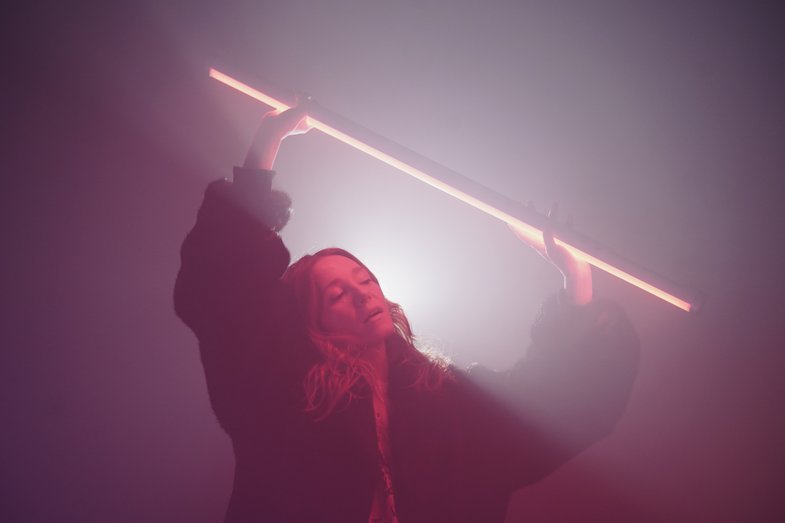
Portrait
Choreographer Kat Válastur loves the ancient myths and fictional fabrications. In her dance pieces, she combines archaic and contemporary elements while exploring essential questions of human existence.
Having been born in Athens, Greece, Kat Válastur studied dance at the Hellenic School of Dance. As the recipient of a Fulbright scholarship, she moved to New York City where she continued her studies at the Trisha Brown Studio. In 2001, she founded her own company adLibdances. A few years later, in 2007, she resumed her studies at the Inter-University Centre for Dance Berlin (HZT), earning a Masters degree after graduating from the Solo/Dance/Authorship program. The research that Válastur conducts for her work emanates from the question “what can we still dance?” Her pieces are based on her own diagrams, drawings, and texts. With the help of this approach, she creates a force field that guides the dancers’ bodies and determines the piece’s specific movements.
The choreographic cycle “Oh! Deep Sea – Corpus I – IV” (2009 – 2012), whose conception was inspired by Homer’s odyssey, introduced Válastur’s work to a wider audience. She did not choose a narrative approach to the famous epic, but instead interpreted it, in a more abstract way, as the body’s aimless wandering through time and space. The minimalist, expressive choreography, in combination with an amplifying sound and light installation, mesmerizes the audience. Each of the selected episodes is approached with the help of a specific set of questions: in part two, which revolves around the Cyclops, she for instance asks whether the impression of monstrosity does not lie in the eye of the beholder. In the final episode, which is inspired by Ulysses’ journey to the land of the dead, she makes use of the fragmentary quality of both memory and movement, showing bodies that are about to lose their contours.
In 2014, Kat Válastur introduced her trilogy “The marginal Sculptures of NEWtopia.” Here, she added a utopian or science fiction element to her thoughts on societal issues. In the solo piece “GLAND,” real and virtual space are interfused to the extent that Válastur appears to be a super hero with miraculous powers. The group piece “Ah! Oh! A Contemporary Ritual” revolves around the desire for new ritualistic practices. In this piece, Válastur draws on the archaic figure of the circle and conceptualizes a round dance for a post-apocalyptic society. The audience faces a group of people who, sitting on ruins in the wake of a 1catastrophe, has to rebuild their lives from scratch. Her most recent choreographic work, “OILinity,” completes Kat Válastur’s trilogy. She here creates the image of a post-apocalyptic society whose existence depends on oil. Válastur engages her three dancers in a game that confronts them with surreal obstacles. Their actions culminate in a ritual involving three bizarre sculptures that constitute a circulating system. Válastur wants to descend into the depth of the human soul. It is not for nothing that her work is based on the assumption that: “a civilization that depends on oil must per definition be a melancholic one.” Each of her very visual works draws on a specific philosophical context. This is why Kat Válastur enters unknown territory with every new piece that she creates.
Sandra Luzina
Biography
Kat Válastur is a Greek choreographer, dancer and performer living and working currently in Berlin. Her choreographic, sonic, and visual practice is rooted in world-making, a process through which she creates new worlds from the ruins of a world that is fading. These remnants, mythical, archaic, and ritualistic in nature, are part of the Mediterranean South, as well as of her personal DNA.
A central element of her practice is the interconnection of sound, music, and rhythm, leading the work to a threshold where choreography meets the concert experience. Within this space the archaic and the contemporary coexist beyond hierarchies or linear time. Her works often incorporate sculptural objects or constructions that function as sonic instruments, such as the semantron and the udu. The interaction between the dancers and these objects generates soundscapes that enrich and expand the choreographic action. Her collaborations with musicians such as Valentina Magaletti and, more recently, Aho Ssan actively shape and expand the sonic dimension of her work.
Her hybrid works also function as contemporary rituals, responding to the need to heal what has been wounded and to restore what has been eroded by the power-driven systems of techno-capitalism.
Válastur was an invited artist at the Institute for Spatial Experiments, a project initiated by Olafur Eliasson. During this period she presented three works as part of the “Festival of Future Nows”, “We Were Better in the Future” (2014, Neue Nationalgalerie, Berlin), “As the Bridge Shakes” (2017, Hamburger Bahnhof), and “MoonJar” (2025, Neue Nationalgalerie)
She was named a promising dance talent by Tanz magazine (2016) and nominated for the George Tabori Prize (2017). Her work has been supported by the Hermès Foundation as part of New Settings (2019) and featured at the Live Works – Performance Act Award, Volume 7, at Centrale Fies, Italy (2019)
In 2022, together with choreographers Ixchel Mendoza Hernández and Jasmin İhraç, and a group of female collaborators from the Berlin dance scene, she co-published the online feminist magazine Spread Magazine for dance and performance. In 2023, she was a resident artist at the Cité Internationale des Arts in Paris.
Her work has been presented internationally at venues and festivals including HAU Hebbel-am-Ufer (Berlin).
She studied dance at the Hellenic School of Dance in Athens and, as a Fulbright Scholar, at Trisha Brown Studios in New York. She later received a Master’s degree from the SODA Master’s programme at the Hochschulübergreifendes Zentrum Tanz Berlin (HZT).
Since 2022, she has been an elected member of the German Academy of Performing Arts, which brings together outstanding artists from theatre, film, television, and radio.