onlinetheater.live
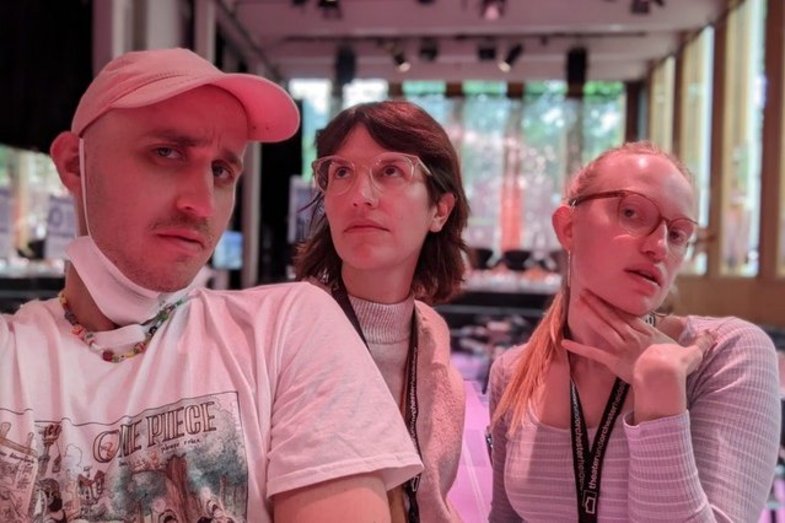
Portrait
Digital theatre art on and with social media in the largest theatre of our reality, the World Wide Web – this is the trademark of onlinetheater.live and its three artists Kathi Kraft, Luzia Oppermann, and Caspar Weimann. The collective not only expands the prevailing concept of theatre by consistently repurposing digital logic in an artistic way and transforming the internet into a platform for contemporary art. It also takes a political and activist approach against spirals of violence as well as increasing radicalisation and hate speech online using artistic means, empathetically and effectively formulating counter-narratives to the dominant narrative patterns of our digital, political, and social present, which has become increasingly anti-democratic.
Whether it’s right-wing propaganda strategies, anti-feminist online content, or radicalising young men in the digital realm, each project undertaken by the collective is preceded by meticulous research. With great sincerity, a deep interest in the positions and lines of argumentation of others, and the ability to listen closely with empathy, the collective takes a keen and critical look at politically and socially relevant contemporary narratives, developing its own elaborately produced (digital) artistic form for each piece of researched content, involving a great deal of creative effort. Building up such unerring expertise in digital theatre projects has required years of intensive – as well as precarious – preparatory work on the part of the collective, with drive and dedication beyond pay, support structures, and funding. In this respect, they share their history with many high-quality collectives that produce innovative work under precarious working conditions over a long period of time. And not all of them are discovered, such as onlinetheater.live, whose innovative form of contemporary art has only been made possible by a consistently transdisciplinary team that is constantly expanding its capabilities.
With this complex way of working, onlinetheater.live leaves the traditional physical theatre space behind. With its move into the online realm, the collective also redefines the concept of liveness referred to in its name. “Live” is no longer necessarily what is being streamed live and performed at that very moment, but rather what the audience experiences on the internet at that very moment and therefore perceives as being presented live. This circumstance opens up new target groups for digital theatre forms with an activist and investigative orientation, while at the same time creating a supposedly more individual involvement of the audience in the performative event. This enables new (digital) experiences and trains of thought that would probably never have taken place online or offline due to a lack of opportunity and willingness to leave one's own bubble.
With their artist and activist orientation, onlinetheater.live’s projects at the same time broaden artistic possibilities in terms of political and democratic education. This does not fundamentally revolutionise the formal use of theatre as an art form, but it does revolutionise the purpose of theatre: depending on the content, the type of acting and speech is aimed toward the given target audience in order to reach viewers in the respective social sphere, prompting them to engage with new content and perspectives as well as to reflect on them emotionally and cognitively. To this end, the respective actors always use a very ‘personal’, direct tone of address, in a manner of speaking typical of the respective audience, thus encouraging them to listen attentively.
With this approach, onlinetheater.live represents a form of theatre that uses artistic means to reconnect and enable communication among online social spheres that are separated from one another, thereby attempting to subversively undermine and disrupt processes of orchestrated social radicalisation through positive counter-narratives, providing a positive alternative that promotes coexistence. The collective makes the knowledge accumulated through this artistic practice available to all interested parties, expressly calling on others to replicate these narrative strategies in order to stand up to radicalising forces in the digital space.
Gesche Piening, Katja Huber and Elsa Büsing
on behalf of the Künstlerische Produktionsplattform by Gesche Piening
Translated by Josephinex Ashley Hansis