Ali Chahrour
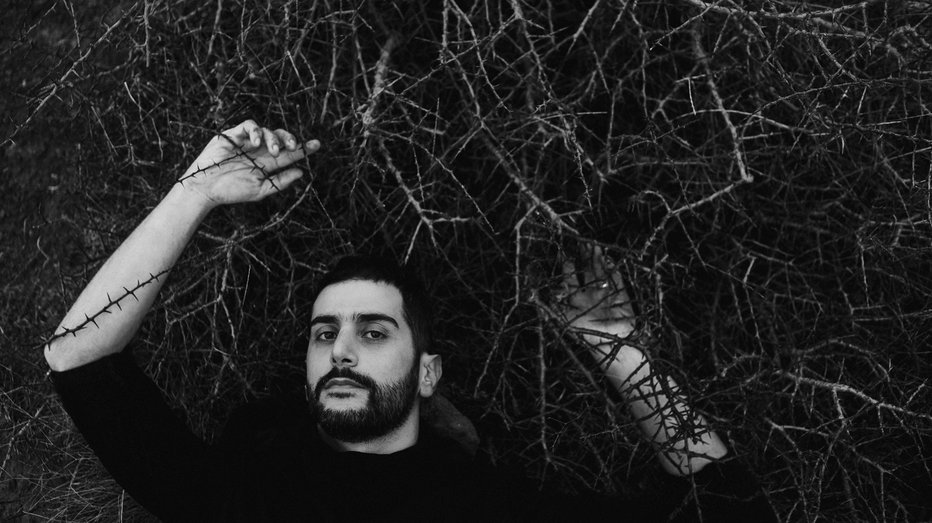
Portrait
Ali Chahrour’s artistic work does not seek to explain the world. Beyond quick statements and short attention spans, his performances create space to perceive more deeply and to bear witness to what is easily overlooked: a small gesture, a voice, a heaviness, a moment of beauty amid uncertain circumstances.
His stage aesthetic is reduced and close to the body. It combines dance, theater, live music, and lighting into concentrated images of grief, love, and resistance. Bodies appear not as symbols, but as carriers of life, as repositories of memory. Slowness, repetition, and silences give their movements time and weight. Minimal and sensual at once, the stage becomes a place where pain, uproar, and unease meet calm, embrace, and consolation, and where people become visible in their dignity, their vulnerability, and their contradictions.
Ali Chahrour’s internationally acclaimed work should not be taken for granted. It bears traces of a reality in which art does not arise from security, but from experiences of loss and connection.
A central source of his work is Beirut, the city where he lives. Chahrour describes the neighborhood where he grew up as a densely populated environment full of stories. Everyday encounters, people’s body language, their humor, their fatigue, their worries, and their ability to carry on under difficult conditions became part of his artistic archive. His work draws from lived experience and from what is stored in homes, families, streets, and bodies.
Ali Chahrour was born in 1989 in southern Lebanon. His father’s home village remains occupied to this day. The family moved to Beirut, fell into poverty, and had to rebuild their lives. Two of his siblings went to Europe to find work. Ali, the youngest, was the only one to choose art. It was a risky path for a young man without a safety net, yet it became possible with his mother’s support. At the Lebanese University, he studied theater and learned to make do with little, to find solutions – through imagination and perseverance. Before his studies, he had never been to the theater. It was only there that he discovered his passion for dance.
However, the Shiite mourning ceremonies that Chahrour witnessed as a young person – and from which he draws personal, cultural, and physical knowledge – can be understood as his artistic moment of initiation. People gather, cry, sing, speak, and move together. Mourning appears as radical presence, as the presence of the absent within the bodies and voices of the bereaved, as a work of keeping memories alive. The funeral becomes an emotional celebration of life, where the social, the political, religion, taboo, love, and pain come together.
His mother gave him the courage to get started. Ali Chahrour’s first stage production bears her name: “Fatmeh” (2014). It marks the beginning of a trilogy about death and mourning rituals. Another relative, Leila Chahrour, a professional mourner who sings at funeral ceremonies, helped him find his own contemporary stage language. “Leila’s Death” (2015) is dedicated to her. In one small movement of Leila’s hand lies the intensity of an entire life. Her songs and gestures also shape Ali Chahrour’s later works, including a trilogy about love, in which Arabic poetry, personal stories, embodied knowledge, and political reality coalesce. In this way, “Told by My Mother” (2021) connects family history with collective memory and tells of the struggles and resilience of mothers in Lebanon.
Since 2024, the renewed war shifted the context for the artist’s work. In Beirut, long-term projects, tours, and fixed schedules can hardly be planned anymore. Uncertainty, economic collapse, and political violence are changing both the external conditions and the inner necessity of artistic practice. Yet Chahrour’s art cannot be reduced to a choreography of crisis. It remains connected to people’s concrete lived realities, along with their financial, social, and emotional implications. This urgency also shaped “When I Saw the Sea” (2025): Against the backdrop of the devastated city, three women rise up against the racist exploitation of domestic workers under the repressive kafala system, using dance, music, and autobiographical storytelling. Sadness, fear, and anger mark these worlds just as much as the longing for beauty, tenderness, and time spent together.
Ali Chahrour therefore thinks of art not primarily as form, but as relationship. His artistic processes begin with long conversations, mutual consideration, and trust. He does not like to stand alone in the spotlight. Again and again, he emphasizes the people who make his works possible and who carry them with him.
An ideal day for Ali Chahrour begins at home in Beirut, in his apartment with the cats. Then, a visit to his mother, lunch together. Later, watching TV… An unfussy day close to the people he loves, those who have stayed.
Maria Rößler
Biography
Ali Chahrour is a choreographer and dancer from Lebanon. He invents a gesture, freed from Western codes and models, which acts as a reflection of his culture and the political, social and religious context in which he evolves. Combining lyrical poetry, raw emotion and tangled bodies, crafting a vivid tapestry of human connection, Ali Chahrour’s performances were presented at Avignon festival and at many other international festivals and theatres around the world.