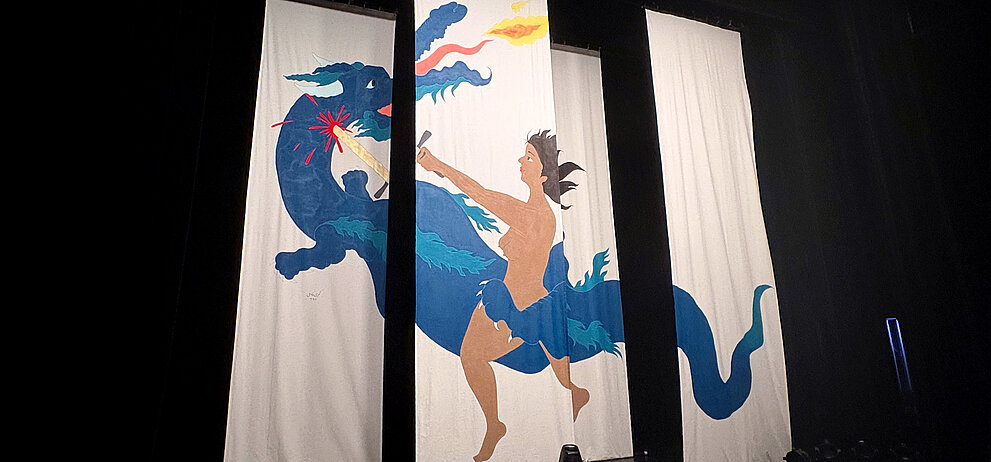
During the festival “Love is a Verb #2 – We, the Heartbroken” HAU1 will become the “Vessel of Love”. The visual focal point is the large-scale textile work “Where Ahriman Whispers…” (2026) by the Afghan artist Kubra Khademi, created especially for the Vessel. The work returns to the mythological landscape of Persia and Khorasan to question, through the body itself, the traditional roles of heroes, dragons and demons. The dragon becomes a manifestation of patriarchal, religious and political violence – and the woman who stands against it takes up the sword herself and becomes the dragon-slayer.
This is what Kubra Khademi says about her work:
“In the ancient cosmology of the Persian world next to Buddha of Bamiyan (today in central Afghanistan), Ahriman is associated with darkness, destruction, deception, and the forces that move against life. But darkness does not always arrive as a visible monster. Sometimes it whispers. It enters through fear, obedience, silence, violence, and the stories we inherit about who we are allowed to become.
Where Ahriman whispers, I place the female body.
My work returns to the mythological landscape of Persia and Khorasan, not as an attempt to reconstruct the past, but to disturb it. I enter the ancient world of dragons, heroes, demons, and battles through my own body, questioning who has historically been given the right to occupy the position of the hero.
The dragon becomes a manifestation of what must be confronted. It carries the accumulated violence of patriarchal power, religious authority, political oppression, and the silencing of women. Yet the woman confronting it is not the passive figure waiting for salvation. She takes the sword. She enters the battle. She becomes the dragon-slayer.
Through the visual language of Persian miniature, I bring an ancient mythology into confrontation with the contemporary female body. The miniature—traditionally a space of kings, heroes, battles, demons, and fantastical creatures—becomes a stage upon which I rewrite my own position within history.
I am not interested in illustrating an ancient myth.
I am interested in becoming part of it.
The woman who kills the dragon does not simply defeat an enemy. She breaks the architecture of the story that made her powerless. She takes the place of the hero and, in doing so, transforms the meaning of the heroic act itself.
But Ahriman continues to whisper.
The battle is never completely finished. Darkness does not disappear simply because the dragon falls. It moves, changes form, enters the body, the memory, the institution, the intimate space.
And perhaps this is where the work begins:
In the place where the monster is no longer outside us,
where the ancient myth begins to speak through the present,
and where a woman finally answers the whisper.”