With Svenja Beller, Gabriela Carneiro da Cunha, Perera Elsewhere, Lea Frerichs, Clara Gonzales (ECCHR), Şermin Güven (Cênî – Das Kurdische Frauenbüro für Frieden e.V.), Cristina Hernandez Hurtado (ECCHR), Saúl Luciano Lliuya, Oda Müller (KlimaSeniorinnen), Luisa Neubauer (Fridays for Future), Maria Cecilia Oliveira, Yi Yi Prue, Eva von Redecker, Erena Rangimarie RereOmaki Rhose, Parid Ridwanuddin, Yolanda Rother, Nova Ruth & Grey Filastine, Miriam Saage-Maaß (ECCHR), Lotta Schäfer (Spore Initiative), Caroline Schroeder (Germanwatch), Nikolaj Schultz, Abdul Mufeez Shaheed (PISFCC), Roda Verheyen, Rose Wanjiku (International Women* Space), Rosmarie Wydler-Wälti (KlimaSeniorinnen), Michał Zadara, Karin Zennig (medico international)
27.–30.11. / HAU1, HAU3
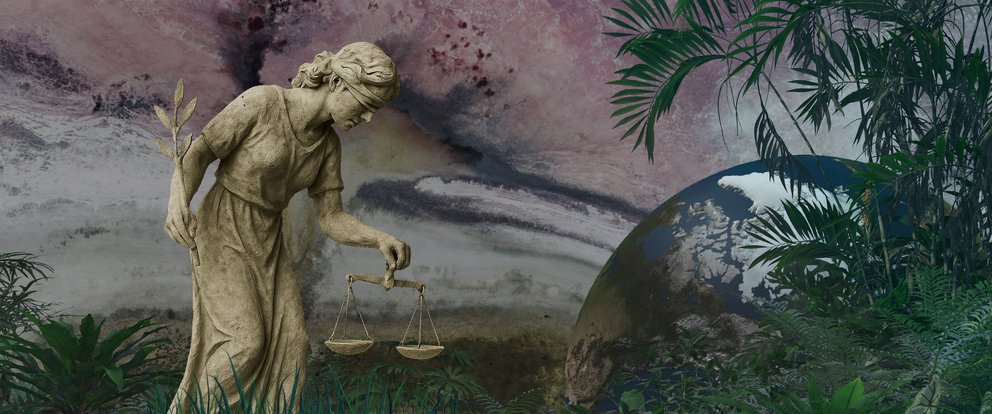
Climate justice draws attention to the unequal distribution of responsibility and consequences of the climate crisis. Law is increasingly being used as an instrument in this context: in climate and environmental lawsuits, people demand from governments and companies to protect their livelihoods. The idea of “rights of nature” also calls for ecosystems such as rivers and forests to be recognized as legal entities. But can climate justice be enforced through legal action? And how does a man-made legal system relate to ecological systems? HAU Hebbel am Ufer invites international legal experts, environmental activists, artists and climate plaintiffs to a four-day, multi-layered focus on planetary justice from a legal perspective.
The centerpiece of the thematic focus is “People’s Court for Climate Trials: A Public Hearing” which brings together environmental litigation groups from around the world – from Switzerland to Peru to the Pacific Islands. They are suing actors, whose actions are exacerbating the climate crisis and violating fundamental rights or international obligations. The Public Hearing plays with the procedures of the courtroom to create a space between political and performative assembly. The protagonists include, among others, the organization Pacific Islands Students Fighting, who fought for the International Court of Justice's advisory opinion in July 2025; Luisa Neubauer (Fridays for Future), who presents the constitutional complaint against the Federal Republic of Germany on the Climate Protection Act, which was won in 2021; and the famous lawsuit brought by Peruvian farmer Saúl Luciano Lliuya against the energy company RWE.
In panels such as the HAU series “On Justice” – a cooperation with the ECCHR – experts such as Nikolaij Schulz and Roda Verheyen from the fields of law and ecology discuss issues surrounding ecological jurisprudence and rights of nature.
Indigenous voices like those of Erena Rangimarie RereOmaki Rhose, and artistic positions focus on relationships with the earth that go beyond the legal framework: Nova Ruth and Grey Filastine, for example, report on their journey on a modified sailing ship – a cultural platform that advocates for climate justice in Indonesian coastal communities.
In her ritualistic performance “Tapajós,” Gabriela Carneiro da Cunha reveals evidence of the mercury-contaminated river landscape and its inhabitants in the Amazon region. Lecture performances by Maria Cecilia Oliviera and Michał Zadara, as well as music by Perera Elsewhere, combine discursive and aesthetic levels and create new visions for the future – between law and justice.