Dramaturgy: Laro Bogan
People’s Court for Climate Trials:
A Public Hearing
With Clara Gonzales, Saúl Luciano Lliuya, Oda Müller, Luisa Neubauer, Yi Yi Prue, Erena Rangimarie RereOmaki Rhose, Parid Ridwanuddin, Caroline Schroeder, Abdul Mufeez Shaheed, Rosmarie Wydler-Wälti, Karin Zennig
Chairs: Miriam Saage-Maaß, Svenja Beller, Yolanda Rother
Expert: Lea Frerichs
12:00–18:00
Part of “On Planetary Justice”
Day ticket “On Planetary Justice” 29.11. >> here
- Dialogue
English /
360 mins.
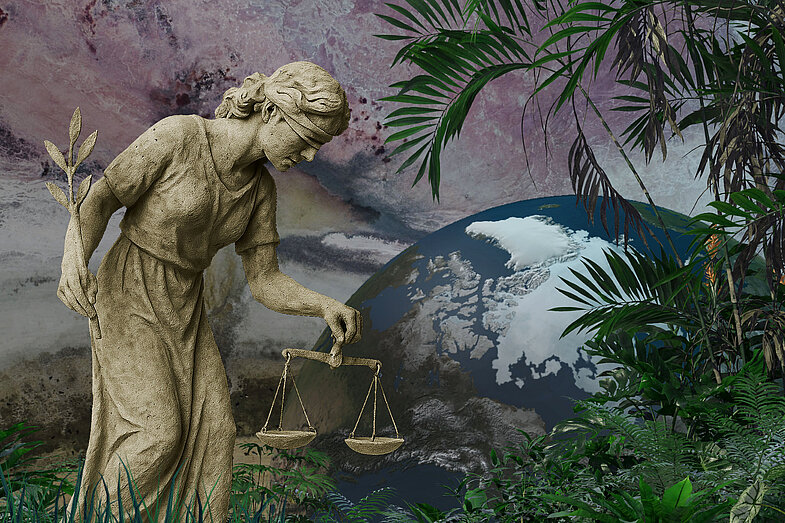
How do we effectively demand justice and accountability for the climate crisis? In this extended Public Hearing, environmental plaintiffs from around the world – from Switzerland and Peru to the Pacific Islands – will come together. They have taken protest from the streets into the courtroom, suing governments and corporations whose actions exacerbate the climate crisis and violate fundamental rights or international obligations.
The Public Hearing plays with the procedures and rituals of a courtroom to create a space between a political and a performative assembly, wherein plaintiffs and their representatives, experts, and lawyers come together. The focus is on international lawsuits through which the plaintiffs demand a drastic reduction of emissions by legal means. On the one hand, governments are targeted to be compelled to further adopting their yet inefficient climate policies. Several landmark rulings for the protection of human rights and future generations have already been achieved. On the other hand, energy and resource corporations are also being held accountable for floods, extreme weather events, or rising sea levels. Overall, the presented cases demonstrate how legal strategies, transnational solidarity, and civil society engagement work hand in hand to demand new forms of planetary justice. Planetary justice is oriented towards respectful relationships within and between communities and societies, towards a balance between species and ecosystems, and focuses on the local level.
Schedule for the Public Hearing
12:00–14:00: Testimony
The first part of the Public Hearing presents and contextualizes the impacts the climate catastrophe has on the plaintiffs and their communities. What environmental disasters are they facing? How are these being negotiated within a legal framework? Which rights are being violated? On the basis of which laws are the cases being filed – and what experiences do the plaintiffs have during their proceedings? Using various cases from Pakistan, Indonesia, Peru, Germany, Switzerland, and Bangladesh, the audience will gain insights into the backgrounds, contents, progress, and strategies of climate lawsuits.
14:00–14:45: Break
14:45–16:30: Examination
The second part of the Public Hearing delves into a deeper debate, examining the potentials and limits of climate lawsuits in the struggle for planetary justice. The central question is to which extent these litigations can be an effective means to counter the systematic inaction of states and the profit interests of fossil fuel corporations. Together, the participants will reflect on the achievements and challenges of these often lengthy processes. The focus will be on aspects such as strategies, effectiveness, community connections, integration into climate movements, media representation, the role of campaigns, developments in jurisprudence, and questions of participation and exclusion.
16:30–17:00: Break
17:00–17:15: Collective Plea
How can we act collectively despite being differently affected by the climate crisis? The Public Hearing concludes with the formulation of a shared vision and demand: In a collective plea, visions, demands, and perspectives for a just future will be articulated. What do we want to achieve – and what is needed to get there?
17:15–18:00: Networking
All attendees, including the audience, are invited to converse with one another, network, and form new alliances. In an open atmosphere, a space will be created for in-depth questions, spontaneous encounters, and shared ideas.
The Climate Lawsuits and their Representatives
Abdul Mufeez Shaheed reports on the journey of the organization Pacific Islands Students Fighting Climate Change to the International Court of Justice’s advisory opinion of July 2025, which establishes, based on international law, the obligation of all states to drastically reduce their emissions.
Clara Gonzales (ECCHR) and Karin Zennig (medico international) discuss a lawsuit filed in October 2025 by more than 43 Pakistani farmers against the corporations RWE and Heidelberg Materials, which is being supported by ECCHR and medico international. The case centers on the massive monsoon floods in 2022, which devastated large parts of Pakistan and were largely attributable to climate change.
Luisa Neubauer, co-founder of Fridays for Future, represents the successful 2021 constitutional climate lawsuit against the Federal Republic of Germany, which subsequently had to adapt its Climate Protection Act. Additionally, she will speak about the currently ongoing “Zukunftsklage” (Future Lawsuit), which focuses on the inadequate adaptation of the Climate Protection Act after the first lawsuit.
Parid Ridwanuddin introduces the Pujianto lawsuit against the Swiss cement corporation Holcim, the pre-trial negotiations for which took place on September 3, 2025. Four Indonesian fishers are suing the “Carbon Major” Holcim, demanding their financial contribution to climate protection measures against the flooding of small Indonesian islands.
Rosmarie Wydler-Wälti and Oda Müller from KlimaSeniorinnen (Senior Women for Climate Protection) present their case against the Swiss government. Following the lawsuit, the European Court of Human Rights ruled in April 2024 that Switzerland had violated the human rights of the elderly women because the country was not doing what is necessary against progressing global warming. Currently, the KlimaSeniorinnen are monitoring the implementation of the ruling.
Saúl Luciano Lliuya and Caroline Schroeder (Germanwatch) report on the Lliuya case, in which the energy company RWE was sued and called upon to contribute to necessary protective measures for Lliuya and his village in the Andes of Peru.
Yi Yi Prue represents her constitutional complaint against the German federal government, which she filed together with indigenous representatives of her Marma community and plaintiffs from Nepal and which was won in 2021. The focus is on landslides and excessive monsoon rains triggered by deforestation and climate change.
The Expert
Lea Frerichs is a PhD candidate and research associate at the Mercator Foundation Professorship for Sociology at the University of Hamburg, where she researches the social dynamics of ecological transformation. Her focus is on legal mobilization in the context of climate lawsuits and protest movements, with a particular interest in impact research. She is a co-author of the annual “Klimawende-Ausblick” (Climate Transition Outlook) and a member of the Center for Sustainable Society Research (CSS), the German Society for Sociology, and the International Sociological Association.
The Chairs
Miriam Saage-Maaß is a lawyer and Legal Director at the European Center for Constitutional and Human Rights (ECCHR) in Berlin. She works on strategic litigation cases against corporations responsible for exploitation and labor rights violations in global supply chains – for example in Bangladesh and Pakistan. Furthermore, she leads criminal proceedings against corporate executives involved in international crimes such as arms exports to war zones. Miriam Saage-Maaß is internationally recognized as an expert on corporate accountability and human rights. She oversees various strategic climate lawsuits at ECCHR.
Svenja Beller is a freelance journalist, author, and moderator. She lives in Hamburg and Lisbon and writes for publications including the “Süddeutsche Zeitung Magazin”, “Die Zeit”, “The Guardian”, and “Der Freitag”, for which she has been writing the environmental politics column “Forst und Wüste” since 2018. She has received numerous awards, including the German Journalist Award, the Hansel-Mieth-Preis, and the German Award for Climate Journalism.
Yolanda Rother is a co-founder of “The Impact Company”, a consulting firm for diversity and inclusion, and a board member of the Stiftung Zukunft Berlin. She moderates and speaks on topics related to digital society, politics, diversity, and sustainability. Rother holds a Master of Public Policy from the Hertie School of Governance and has lived in Brazil, France, and the United States.
Team
Dates
Past
Location
HAU1
Stresemannstr. 29, 10963 BerlinThere are two marked parking spots in front of the building. Access to the Parkett by means of a separate entrance with lift when necessary. Barrier-free restroom facilities are available.