Heartbreak is at the heart of all revolutionary consciousness. (“We, the Heartbroken”, Gargi Bhattacharyya)
The “Vessel of Love” forms the heart of the “Love is a Verb #2” festival: a space for encounters, conversations, concerts, performances and lectures. Inspired by Ursula K. Le Guin’s “Carrier Bag Theory of Fiction”, HAU1 becomes a vessel for many voices, stories and perspectives. What do we need in the face of the rise of fascism, war and the climate crisis? Through speaking, listening, singing and simply being together, the Vessel momentarily interrupts social isolation and creates a space for resistance, solidarity and mutual support – and for exploring how we can look after one another in an increasingly heartless world.
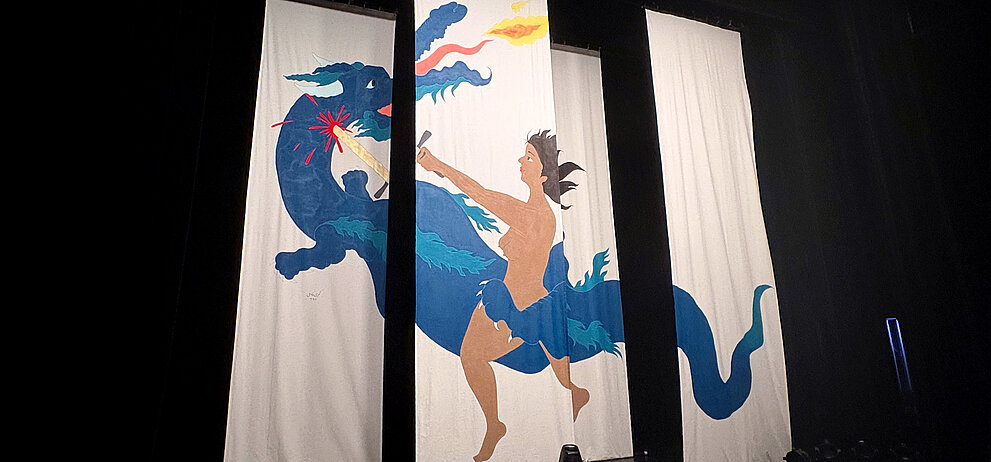
In the theatre, we usually all face the same direction: straight towards the stage, row upon row, with our backs to one another. Within the Vessel, the familiar layout of the theatre is transformed: at HAU1, several rows of chairs are removed and replaced with a variety of seating options. This alters our relationship with the space: we no longer face solely towards the stage, but can turn towards one another. The visual focal point is the large-scale textile work “Where Ahriman Whispers…” (2026) by the Afghan artist Kubra Khademi, created especially for the Vessel. The work returns to the mythological landscape of Persia and Khorasan to question, through the body itself, the traditional roles of heroes, dragons and demons. The dragon becomes a manifestation of patriarchal, religious and political violence – and the woman who stands against it takes up the sword herself and becomes the dragon-slayer.
This reimagined space will be inaugurated with a concert by SOAP&SKIN. A central part of the programme is “Politics of Heartbreak”, the Vessel’s artistic and discursive series. Over three sessions, we will explore what political heartbreak means and how personal feelings of loss, alienation, grief and exhaustion are linked to political realities. We kick off with a packed double-bill: together with internationally active authors, journalists, activists and artists, we will discuss exile, war, authoritarianism and racism – and how we can remain connected to one another despite all these crises. “Politics of Heartbreak #1: Finding Home in Becoming Strangers” will be opened by the SEYYARE Anatolian Women’s Choir. This will be followed by a keynote by the author Ece Temelkuran on the loss of home and democracy. The subsequent discussion with the journalist Sham Jaff will explore how personal heartbreak can be transformed into a form of political solidarity. The post-German artists’ collective parallelgesellschaft will bring this section to a close with a musical and politically poetic intervention.
That same evening, the series continues with “Politics of Heartbreak #2: Mourning as Resistance”. In their lecture-performance “Not a Body for Burial”, the collective Rebel-Ist-hah! and Azadeh Ganjeh take an anonymous protest video as their starting point to explore visibility, loss and agency. This will be followed by a discussion moderated by Sham Jaff with Azadeh Ganjeh, Simin Jawabreh and Kubra Khademi, broadening the perspective on resistance as mourning across Iran, Palestine and Afghanistan. Throughout the evening, Berlin Tatreez invites visitors to join in a collective embroidery session in the Vessel – moving from political analysis back to shared experience and encounter.
On the second weekend of the festival, Şeyda Kurt and Alice Hasters will discuss, in “Politics of Heartbreak #3: How to Keep Going with Broken Hearts?”, how sustaining feelings of connection and vulnerability can become a source of social resilience in the face of crises and rising authoritarianism. The evening concludes with the choir D-Dur Dykes* performing lesbian and queer pop, creating a moment of collective connection through shared singing.
The other evenings at the Vessel also navigate the space between personal experience and political realities. In “Before What Came After”, the renowned visual artist Vlatka Horvat, together with international female artists living in Berlin, transforms personal photo archives into narratives about migration, diaspora and everyday resistance. In “Cabaret Heartbreak”, hosted by Thelma Buabeng and Olympia Bukkakis, seven Berlin-based artists respond with short acts to the festival’s eponymous text “We, the Heartbroken” by Gargi Bhattacharyya, countering cynicism and exhaustion with wit and radical tenderness.
The Vessel concludes with the Wedding Ceremony by the queer-feminist artists Annie Sprinkle and Beth Stephens. With their film “Playing with Fire – An Ecosexual Emergency” and their joint “Ecosexual Wedding Ritual to Fire”, they transform loss and fire into an ecosexual declaration of love to the Earth.
So: especially if you’re heartbroken, come to the Vessel of Love! We’re here – and we’re not alone.